Showing posts with label motor. Show all posts

Saturday, 16 February 2019

F1: Ferrari presents 2019 race car


(ANSA) - Maranello, February 15 - Ferrari presented its 2019 Formula One race car - the SF90 - at its Maranello headquarters on Friday. Ferrari President John Elkann, CEO Louis Camilleri, new team principal Mattia Binotto and drivers Sebastian Vettel and Charles Leclerc were present, along with Piero Ferrari, the son of late founder Enzo Ferrari.


"I can't wait to get in the car and start," said Germany's four-time world champion Vettel.
"Each time the excitement is incredible.

"As a team we are on the right road. Let's hope we keep improving". Ferrari have drafted in talented youngster Leclerc to replace Kimi Raikkonen this season as they seek to end a long drought of world titles. Leclerc said that: "I prepared the maximum I could during the winter break, physically and mentally". Ferrari's last constructor's championship win dates to 2008 and the last drivers' title goes back to when Raikkonen won in 2007 during his first of two stints with the team.

"In 2018 we got really good achievements," said Binotto. "This car is a development of last year's car, it's not a revolution. "We've tried to push the bar, try to be some extreme as we could. "Some changes like the front wing for the regulations. "If you look at the details, we've tried to push hard, be innovative. "If you look at the bodywork at the back, it's very slim.

"It's thanks to the entire job we've done. A lot of effort has been done. We like it".

One of the most striking aspects of the new car is its colour - a red that is slightly less bright than the hue Ferrari usually go for.

The name SF90 refers to the fact that this year is Ferrari's 90th anniversary.

"The car embodies the latest state of the art technology, reflects the new regulations for the coming season and is the fruit of the combined enormous work and talent of everyone in the Scuderia," said CEO Camilleri.

Source: ANSA

Monday, 22 May 2017

Fernando Alonso fifth in Indy 500 qualifying as Scott Dixon takes pole

Fernando Alonso will start his first Indianapolis 500 from the middle of the second row of the grid after qualifying fifth for the race on 28 May.

The McLaren Formula 1 driver set an average of 231.300mph on his four-lap qualifying run, while New Zealander Scott Dixon took pole at 232.164mph.

It was an impressive performance from the two-time F1 champion - he had not driven an IndyCar until this month.

Alonso said he was "happy" but had been slightly delayed by an engine issue.

"I think the car was better than yesterday," he said. "We had an over-boost problem (with the turbocharger) in the final corner, so the engine was like hitting the brakes and I lost a bit."

The Spaniard said this cost him 0.3-0.4mph on his average, which equates to the difference between fifth and either second or third.

Alonso, whose engine needed to be changed between final practice earlier on Sunday and qualifying, added on his Instagram account: "With everything that has happened today being among the top five is a dream.


"Fifteen days ago I would never have thought about fighting for the pole. Thanks to the whole team. Now another week of learning and race next weekend."

To put Alonso's performance into context, 1992 F1 world champion Nigel Mansell qualified eighth on his debut in 1993, in what was the Englishman's fourth IndyCar race after switching to the US-based series.

Alonso's first taste of Indianapolis was in his 'rookie' test on 4 May. He is missing next weekend's Monaco Grand Prix to race at the speedway as part of his quest to win the so-called 'triple crown' of Monaco, which he has won twice, Indy and the Le Mans 24 Hours sportscar race.

The 35-year-old Spaniard is directly behind two former F1 drivers on the grid.

American Alexander Rossi, who had a brief career with the back-of-the-grid Caterham and Marussia teams, was third and Japan's Takuma Sato, who raced in 90 grands prix for the Jordan, BAR and Super Aguri teams, was fourth.

American Ed Carpenter takes the middle slot on the three-car front row.

Rossi won the Indy 500 from 11th on the grid last year, an illustration of the fact that qualifying positions are not of great importance in predicting race form at the so-called 'Brickyard'.

That is because the set-up of the cars is changed significantly between qualifying and race to ensure drivers can run consistently in heavy traffic during a 500-mile race that is usually punctuated by several 'caution' periods in which drivers are restricted to reduced speeds behind a pace car.

Alonso was consistently fast through the days of practice last week, whether running in qualifying or race trim.

None of the British drivers in the field were in the 'fast nine'. Ed Jones was 11th on his debut, followed by Max Chilton in 15th, Jay Howard in 20th, Jack Harvey in 27th and Pippa Mann in 28th.

Source: http://www.bbc.com

Thursday, 11 May 2017

Ferrari races chariot on ‘Ben-Hur’ track

In a modern spin on “Ben-Hur,” a Ferrari took on a two-horse chariot Thursday at a dirt track near Rome.
Fabio Barone spotted the chariot a half-lap headstart and also agreed not to use the traction-control technology on his Ferrari 458, Agence France-Press reported.
He still won, by a few seconds.
The duel took place on the track built at Cinecittà World for last year’s remake of the movie “Ben-Hur.”

Source: http://www.mercurynews.com

Tuesday, 25 April 2017

Camaro ZL1: Most Powerful Camaro in history

The 2017 Camaro ZL1 is poised to challenge the most advanced sports coupes in the world with unprecedented levels of technology, refinement, track capability and straight-line acceleration. In the Middle East, we will be able to ride the most powerful Camaro in history, and learn the real value of big power, big noise, and total control in the first half of 2017. 


The ZL1 delivers significantly enhanced performance in a more aggressive body and a lighter architecture. Needless to say, sports enthusiasts won’t be disappointed, as the supercharged coupe delivers more power than any other Camaro to date and features the most comprehensive aerodynamic package.

And the fact that it is about 90 Kg lighter than its predecessor adds to the thrill and sets a new benchmark in the supercharged muscle car market.

The 2017 Camaro ZL1 sports an excellent stylish design which gives the car a purposeful, super aggressive attitude. The sports car sits on unique, staggered 20-inch forged aluminum wheels wrapped in Goodyear Eagle F1 SuperCar tires.

“The Camaro ZL1 is designed to excel at everything, delivering on design, dependability, quality and performance,” said Abdallah Madhoun, Regional Sales and Marketing Manager for Chevrolet, GM Middle East.

Functionality defines the Camaro ZL1’s form, with the exterior shaped during more than 100 hours of wind-tunnel testing and on-track validation to improve aerodynamics and cooling for track use. Accordingly, its exterior elements all play a part in managing airflow over, under and through the ZL1.

The lower grille opening, for example, offers greater airflow compared to the Camaro SS, and the upper grille incorporates a new version of the “flow-tie” open bowtie insignia. There’s also a new hood, with a carbon fiber insert and heat extractor that pulls hot air from the engine compartment.

Inside, there are standard Recaro front seats, along with a suede flat-bottom steering wheel and shift knob. Chevrolet’s Performance Data Recorder is available.

The ZL1, available as a coupe and a convertible, shares with the Corvette Z06 its herculean power-plant, the supercharged LT4 6.2L V-8 engine. It is rated at 650 horsepower and 650 lb-ft of torque (881 Nm), making this the fastest Camaro ZL1 in the vehicles 50 year history.

Its 0-100 Km/h time is a mere 3.6 seconds, and it can complete the quarter mile in 11.4 seconds at a speed of 204 Km/h.

The Camaro ZL1 is the first production car to use a new, advanced 10-speed automatic gearbox, which offers strong economy and performance benefits. It is also available as a six-speed manual.

The 2017 Camaro ZL1 comes standard with customizable launch control, which allows drivers to adjust launch rpm and wheel slip to dial in the perfect start.

Moreover, a cohesive suite of performance technologies tailors ZL1’s performance for street and track. Features include an updated Magnetic Ride suspension, Performance Traction Management, electronic limited-slip differential and Driver Mode Selector. It also has a stronger power-to-weight ratio than its predecessor, weighing 200 pounds less, while offering approximately 60 more horsepower and 80 more pound-feet of torque.

The result is a one-of-a-kind driving experience.

Finally – and unlike some competitors – there’s no need to purchase an optional package to make the ZL1 track ready. Track capability comes standard, with features including an impressive 11 heat exchangers for optimal powertrain cooling. Camaro ZL1 should scare the best of the best.

Source: http://www.msn.com

Sunday, 23 April 2017

W-Motors Lykan Hypersport, the Middle East’s take on the supercar

Over the years, we’ve seen many iterations of the world’s most expensive vehicle and motor companies are always trying to out-do one another. While the likes of Ferrari, Lamborghini, Bugatti and Mclaren have been fighting it out for years, some newer companies have joined the fray recently. Some succeeded, such as Hennessey, but most others never made it to production. However one stands out from the rest.


Headquartered in Dubai, UAE, W Motors have created the Lykan Hypersport which is the first Middle Eastern Supercar. It’s coincidentally one of the world’s most expensive retailing cars at a whopping 3.4 million U.S Dollars (approx.12.4 million AED) and has been receiving a lot of attention after appearing in films like Fast & Furious 7 and video games like Driveclub and Project Cars.

The Lykan Hypersport is currently the third most expensive car in the world. Ahead of it is the Lamborghini Veneno of which four were built and three were sold for 4.6 million U.S Dollars (approx. 16.8 million AED) as well as the one-of-a-kind Maybach Exelero which cost 8 million U.S Dollars (approx. 29.8 million AED. Originally a test mule for tyres but was eventually sold to a customer.

Why so expensive? The headlights may look like standard adaptive xenon and LED headlights on the W Motors Lykan, but with a closer look you’ll find that they have titanium plates which are encrusted with 420 diamonds! If diamonds aren’t your thing, you can choose from a variety of other precious stones such as rubies, emeralds or sapphires. The entire body of the car is made from carbon composite to reduce the weight of the car. Inside it gets better, LED ambient lighting with a carbon fiber finished centre console with all the standard features such as navigation and Bluetooth connectivity, which are displayed on a 9″ holographic mid-air display with gesture recognition. The dashboard instrument panel is fully digital and shows all relevant information such as speed, what gear the car is in and the revs as well as other information such as efficiency and engine performance.

When it comes to the seats and dashboard, they’re completely customisable. For the seats there’s a choice between Alcantara or leather in any colour with single or double stitching with gold wire, that are placed in a carbon fibre mold to keep the driver and passengers body and neck stable at high speeds.

Why so expensive? The headlights may look like standard adaptive xenon and LED headlights on the W Motors Lykan, but with a closer look you’ll find that they have titanium plates which are encrusted with 420 diamonds! If diamonds aren’t your thing, you can choose from a variety of other precious stones such as rubies, emeralds or sapphires. The entire body of the car is made from carbon composite to reduce the weight of the car. Inside it gets better, LED ambient lighting with a carbon fiber finished centre console with all the standard features such as navigation and Bluetooth connectivity, which are displayed on a 9″ holographic mid-air display with gesture recognition. The dashboard instrument panel is fully digital and shows all relevant information such as speed, what gear the car is in and the revs as well as other information such as efficiency and engine performance.

When it comes to the seats and dashboard, they’re completely customisable. For the seats there’s a choice between Alcantara or leather in any colour with single or double stitching with gold wire, that are placed in a carbon fibre mold to keep the driver and passengers body and neck stable at high speeds.

Only 7 W Motors Lykan’s will be built, one W Motors Lykan is for sale in Dubai, which is number 1 of 7. Even the Abu Dhabi Police has recently acquired one into its police force. Although there may not be any space to put the bad guys in the back, it’s sure to turn a head or two or at least stop some speed demons and reckless drivers.

Source: www.dubicars.com

Monday, 6 March 2017

The ambitious Lexus R CF GT3


The Lexus RC F GT3 signals an ambitious foray into the world of sports cas racing for Lexus engineer Yukihiko Yaguchi and Yukihiko Yaguchi explains how, and why has a lot to be proud of. A chief engineer at Lexus, Yaguchi is the man behind the RC F GT3, a heavily modified version of the RC F, Lexus’s new high-performance coupe.

He’s proud of the car, which will soon sit at the pinnacle of Lexus’s performance-oriented range. He’s proud that Lexus has become one of the few Japanese manufacturers to develop a vehicle compliant with the strict parameters of GT3, a grand touring motor-sport category that abides by regulations set by the FIA (Fédération Internationale de l’Automobile), the world’s governing body for auto racing events. And he’s proud that his car is being so widely acknowledged.


The RC F GT3 is the latest model in the Lexus F range, a division of cars largely associated with performance, precision and progressive technology. The range includes the widely lauded Lexus LFA, a two-seat coupe that has competed in various endurance races.

“The history of the F range actually began with the IS F in 2007,” explains Yaguchi. “Since then we’ve launched several game-changing models – both concept cars and production vehicles – but this sports car definitely represents a highlight.” When the RC F GT3 Concept was unveiled at the 2014 Geneva International Motor Show, in March, it generated a wealth of justified hype, and plenty of headlines. It made clear Lexus’s ambition to make its presence felt on the racetrack, where previously it had little bearing, and it proved Japan’s ability to manufacture, from start to finish, a world-class sports car.

“We’re now in the process of fine-tuning the vehicle,” says Yaguchi. “Once it’s done, we’ll start supplying the cars to racing teams to race in the 2015 season. GT3 cars can enter countless races around the world, including the 24-hour race at Nürburgring, in Germany, and the United SportsCar Championship (USCC) in the US. It’s great that many racing fans will get to see our product in action.”

Like the Lexus RC F, the most powerful V8 performance model the brand has yet developed, the RC F GT3 is full of engineering features aimed at extracting the best out of its 540-plus horsepower engine. The car will be an asset to any race team. Its purpose-built front fenders and front-end underbody treatment have been designed to minimize drag.

Its rear spoiler stands tall and wide to provide the car with enough downforce to improve stability (and therefore increase its speed) around bends. And “Lexus’s latest carbon fiber technology has been applied wherever appropriate,” says Yaguchi, “to keep the car’s weight to a minimum.” He continues: “With attention to detail in mind, we’ve fine-tuned everything from the car’s agility and handling response to the mechanics of its onboard devices. We have here a very serious racing car. But at the same time, drivers of all skill levels would be able to enjoy driving it on circuits around the world.”

Source: https://www.lexus-int.com

Saturday, 29 November 2014

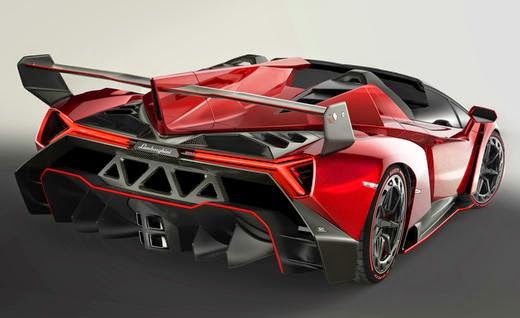
Lamborghini Veneno Roadster


By Diego Braghi: making its debut at the Geneva Motor Show, this open racing prototype has been launched to celebrate the Lamborghini’s 50th anniversary. The venue was the Italian naval aircraft carrier Nave Cavour at a special event in Abu Dhabi in June 2014.

Two of the Lamborghini Veneno Roadster’s most distinctive features are the carbon intensive construction and competition derived aerodynamics.


The monocoque has been built in carbon fibre with aluminium front and rear frames and also the interior trim is made of a substance called CarbonSkin. The carbon-fibre monocoque keeps the Veneno Roadster down to an impressively low 1,490 kg dry weight.

Upfront, the Veneno Roadster features a large aerodynamic wing with huge channels and Y-shaped angular headlamps, and Lamborghini placed large plus four sizable exhaust pipes divided by a splitter on the backside. Keeping the monstrous engine behind the seats cool are large vents, while an adjustable rear wing adds much needed downforce.

The engine, a 6.5-liter V12 with 750 horsepower at 8,400 rpm, mated with seven-speed ISR paddleshift gearbox, propels the Lamborghini Veneno Roadster up to 221 mph (355 km/h), taking 2.9 seconds to make this extreme car from zero to 62 mph (100 km/h). 


The wheels have been designed to improve brake cooling, with the carbon fibre ring around the edge channelling cool air to the carbon ceramic discs. The Veneno Roadster is equipped with front and rear horizontal mono-tube damper with push-rod system and permanent all-wheel drive.

Limited to nine units, the £2.8 million (euro 3.3 million) Lamborghini trumps the Bugatti Veyron as the most expensive supercar on sale.